Consultation

Appointment

Directions

Before & After



The Square Dental Clinic · Reviewed by a specialist dentist (Seoul National University School of Dentistry graduate) · Gwanghwamun, Seoul

If the bonding (tooth-colored composite resin) on a front tooth no longer matches the teeth around it,
the first step is to find out what has actually changed, not to pick a treatment from someone else's results.
Many people searching for answers come across terms like "minish veneer reviews" ,
but another person's photos cannot tell you what your own teeth need.

Here are four things to check before deciding.
Bonding can change in color and shine over time depending on how long it has been in place
and on your oral environment, and the cause is not the same for everyone.

Composite resin is used to restore a tooth in a color close to the natural tooth,
and it can be affected by pigments in food and drink and by conditions in your mouth.
But a front tooth that "looks discolored" does not always have a single cause. It may be:
That is why it helps to check the current condition of the tooth and the existing restoration before choosing a method.
Not necessarily.
Discolored-looking bonding does not automatically mean all of it must be removed or
that a particular cosmetic treatment is needed.

Depending on the condition of the existing restoration and your natural tooth,
redoing the bonding may be an option, and other treatments may also be worth discussing.
A dentist typically reviews the following together:
| What to check | What is looked at |
|---|---|
| Existing restoration | Size, edges, and any damage |
| Natural tooth | How much healthy tooth remains and its current condition |
| Tooth shape | Whether the shape needs further evaluation |
| Bite | Forces on the front teeth and how the teeth meet |
| Gums | The condition of the tissue around the area |
Rather than asking "My bonding is old, so what should I replace it with?", it is more useful to ask
"Given my teeth today, which areas actually need treatment?"

The scope of treatment depends on your condition and the exam findings.
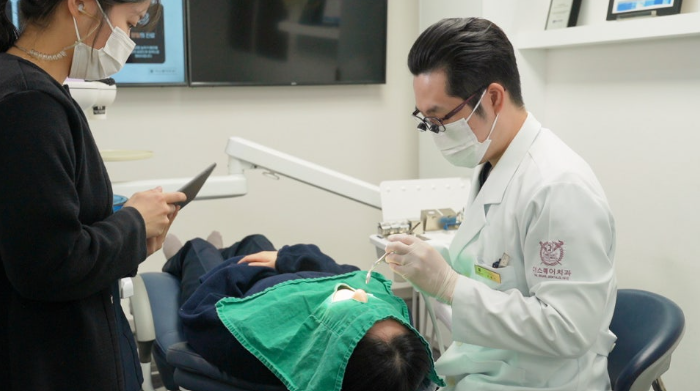
Look at what photos cannot show: the condition of the natural tooth and existing restoration before treatment,
why that method was considered, and what aftercare and precautions followed.
When reading veneer reviews online, the photos tend to draw the eye first.
But everyone starts from a different place. One person may have a large existing restoration,

while another may have much more natural tooth left.
When the starting condition differs, the same plan cannot simply be applied.
Yes. When you smile or speak, the neighboring teeth and gums are seen together, so it helps to review the problem tooth along with what surrounds it.
If the color of an older restoration bothers you,
the color and shape of the neighboring teeth can be reviewed at the same time when a plan is made.

Choosing a method by color alone is less reliable than reviewing the whole picture first
and then confirming the scope of treatment that is actually needed.

The Square Dental Clinic is in the D-Tower in Gwanghwamun, central Seoul, about one hour from the airport, which suits both short-stay visitors and expatriates.
Here is what overseas patients most often ask about:
Results vary between individuals.
Whether a treatment is suitable and how far it should go cannot be judged from online information alone. Please decide carefully after a full review of your own teeth. Results vary between individuals.
A. No. A dentist first checks where and why the change occurred and the condition of the restoration and natural tooth,
and then considers whether to redo the bonding or consider another option.
A. No. It may be surface staining, or a color difference between the natural tooth
and the bonding that has become more noticeable. The cause varies from person to person.
A. It is not advisable. Photos do not show the starting condition of the teeth and restoration
or why the method was chosen, so those need to be checked as well.
A. Yes. Because the surrounding teeth and gums are seen when you smile, the color of adjacent teeth,
the length and width of the front teeth, gums, and bite can be reviewed together.
A. Not reliably. Suitability and scope need an in-person exam of your current teeth.
International patients are welcome to contact us before a trip.